
How To: Set Achievable Native Gardening Goals
Sure, I could tell you why you should start a native garden. I have a whoooole laundry list of reasons.
But if your reason for doing it isn’t personalized and intuitive, then it’s not going to stick.
That’s why the first step is to set personalized, achievable native gardening goals.
Setting a native gardening goal can:
- prevent burnout
- keep you on track
- and help you celebrate success when you reach it.
In this post, I’ll teach you how to distill your native gardening goal into an achievable reality.
Table of Contents
Why “Start A Native Garden” Is An Ineffective Goal
As a goal, “starting a native garden” is too broad. It doesn’t help you decide where to plant your garden or what plants to pick. And it leaves you wondering how to even evaluate whether your effort has been successful. It leaves you with a huge task and all the overwhelm that goes with it.
Plus, starting the native garden is only half the battle. Once it’s in, you have to help it get established and maintain it. Your goal should encompass enjoying your native garden, too. A solid native gardening goal goal gives you a road map so that you don’t get disoriented by decision fatigue and shiny object syndrome.
Ecological Function + Personal Fulfillment
Most native gardening goals fall into two main categories:
Ecological function + personal fulfillment.
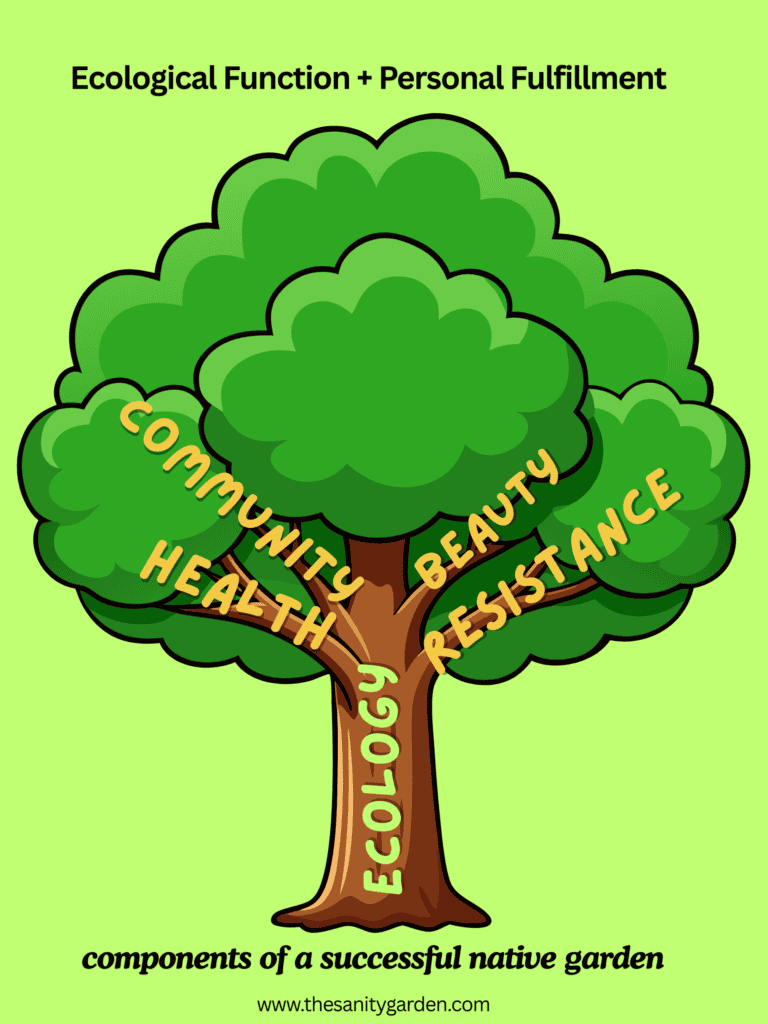
I like to picture these categories as a tree.
The roots and trunk of the tree represent the ecological function of a native garden.
The branches of the tree represent different passions, curiosities, and practicalities.
As a whole, the tree symbolizes a viable native garden that feels rewarding to manage.
An achievable and realistic native gardening goal will incorporate inspiration from both categories.
Ecological Function
Lots of people want a garden, including you. But you don’t want just any garden. You want a native garden. Why is that?
I’m guessing it’s because, on some level, you appreciate the ecosystem services that you receive from nature. And you want to protect the sensitive relationships that sustain these services.
Ecosystem services are “the structures and functions of the natural world that make life possible” (Kimmerer, 2013, pg. 149). We’re talking about the big, main things here. Like food. Water. Oxygen. If we curtail ecosystem services in our communities – through overdevelopment, pollution, and lawns – then life isn’t possible.
This reality makes choosing native plants – instead of showy, exotic ornamentals or chemical-doused lawns – a no-brainer. It’s an admirable decision that showcases selfless, proactive thinking and strong environmental values.
(That’s not to say folks with manicured lawns are selfish or insensitive. We’ve all been brainwashed to uphold the lawn-proud status quo, and it takes lots of deconditioning to view the world through a wilder lens. I was in my 20s before I even gave lawns a second thought, and it’s in my 30s that I’m actually now taking action towards unlawning. The process from awareness to action can be slow.)
Our responsibility towards the environment gives life purpose and meaning, and if we neglect this responsibility, we experience discontent. According to Robin Wall Kimmerer, in her book Braiding Sweetgrass, “Philosophers call this state of isolation and disconnection ‘species loneliness’ – a deep, unnamed sadness stemming from estrangement from the rest of Creation, from the loss of relationship” (Kimmerer, 2013, pg 208-9).
Planting native gardens is a direct and immediately impactful way for homeowners (or even renters) to make sure that our children and our wild neighbors are able to sustain themselves with clean water, abundant food sources, and quality habitat for many years to come. It helps us repair our relationship with the planet and with each other. This is gardening aligned with ecological function.
Personal Fulfillment
We want to plant native species because we care about the environment. But why do we even want a garden to begin with?
There are many ways to contribute to environmental causes, like donating to a conservancy or volunteering at a tree planting. Lots of these options may actually feel much easier than starting your own garden. But that’s the thing about people who get into gardening: logic doesn’t apply. Values like beauty, community, and gratitude apply. Fantasy applies.
First, you learn a small amount about native gardening. Then, you daydream about the potential for your own garden. And seeing the project through begins to feel essential.
Maybe you think, “I’ve been meaning to plant a tree out front. I can add some native plants nearby while I’m at it.”
Or you wonder, “What kind of flowers should I plant to honor my Grandma Jo?”
There are probably as many reasons for starting a garden as there are people who garden. Here is a non-exhaustive list of native gardening goals that can be highly-personalized:
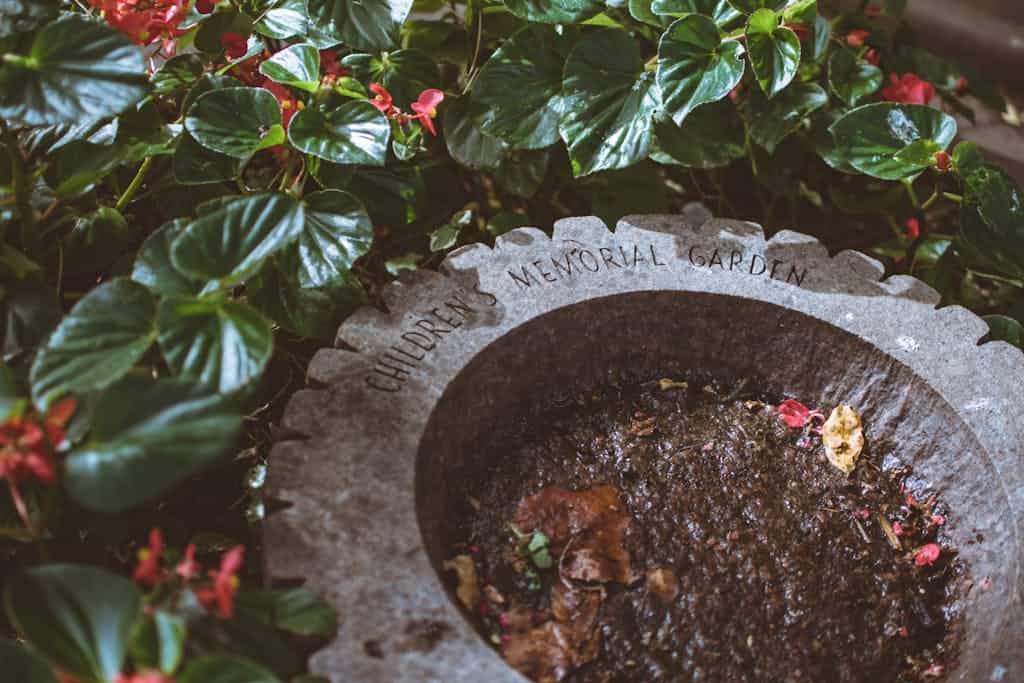
- Memorial Garden: A sweet way to honor a pet or cherished person in your life.
- Commemorate a milestone: Did you: get married? buy a new house? have a baby? run a marathon? write a book? graduate? celebrate a birthday? Plant a native garden to showcase pride and gratitude.
- Resist! From Ben Vogt of Prairie Up: “Make no mistake, fighting for justice on behalf of plants, animals, and ecosystems is directly related to the fight made for women, people who aren’t white, people who aren’t straight, people who live in poverty, people who don’t practice Christianity, etc.” Read more here.
- Beautify the block: Delight and inspire the neighborhood with the color and luminescence of flowers, birds, and butterflies.
- Property pride: Increase your home’s value with an intentional native garden.
- Health: Boost your mental health and get exercise outdoors while enjoying and maintaining your native garden.
- Save time and money: A native garden requires time and money for installation and early establishment, but with each passing season it requires less water and inputs than a typical lawn.
- Convert an existing garden: If you’re already an avid gardener, switching to native species can be a rewarding passion project.
How to create an achievable native gardening goal
You don’t need the “perfect” goal to start. You need a native gardening goal that’s specific enough to guide decisions and flexible enough to fit real life. Use this step-by-step process to connect the roots (ecological function) to the branches (personal fulfillment), then distill everything into one doable direction.
Step 1: Brainstorm your “roots” (ecological function)
Pick one ecological function to prioritize. You can add more later.
Choose what feels most meaningful and most possible for your site.
Ecological function prompts:
- Support pollinators (bees, butterflies, moths)
- Support birds (food, nesting cover)
- Increase biodiversity (more species, more habitat layers)
- Manage water (slow it down, soak it in, reduce runoff)
- Replace lawn inputs (less mowing, fertilizer, pesticides)
- Create habitat (host plants, shelter, overwintering spots)
Write a one-sentence “root intention”:
- “I want my garden to provide reliable food and shelter for local insects and birds.”
- “I want to turn this problem spot into a healthier water-absorbing area.”
Keep it broad for now – this is your why, not your plan.
Step 2: Brainstorm your “branches” (personal fulfillment)
Now choose one personal motivation that will keep you coming back when it’s hot, busy, or weedy.
Personal fulfillment prompts (use these for inspiration):
- Beauty and seasonal color
- A memorial or meaningful story (a person, pet, milestone)
- A place to sit, drink coffee, or decompress
- A project that connects you to your neighborhood/community
- Pride in your home / curb appeal
- A learning project (ID-ing plants, photographing insects, etc.)
- Health: time outdoors + gentle movement
- Practical ease: saving time, water, and money long-term
- A values-aligned act of care/resistance
Write a one-sentence “branch intention”:
- “I want a small space that feels calming and beautiful from my kitchen window.”
- “I want a garden that honors my grandma and gives me a reason to be outside.”
Step 3: Combine them into a “tree goal” statement
This is where the framework clicks: roots + branches.
Use this template:
Template:
This season, I will (create/do) [project] in [specific location] so it can [ecological function] and also [personal fulfillment]—within [time/budget/effort boundary].
Example:
- “This season, I will convert the 4’×8′ bed by the front steps into a native pollinator patch so it can support bees and butterflies and also make my entryway feel welcoming—using under $200 and 1–2 hours a week.”
Don’t worry if it still feels a little wordy. We’ll refine next.
Step 4: Make it achievable by choosing ONE focus area + ONE season
If you’re overwhelmed, your native gardening goal is still too big.
Downshift questions:
- What’s the smallest area that would still feel meaningful?
- What can I do in one season (not “forever”)?
- What’s the simplest version of this that still honors my intentions?
Rule of thumb: if you can’t describe the project in one breath, it’s probably too large.
Step 5: Define “success” with 3 concrete markers
A good native gardening goal tells you how to evaluate progress without perfection.
Pick one marker for the roots, one for the branches, and one for feasibility.
Ecological success examples:
- I included at least X native species with overlapping bloom times.
- I planted at least X host plants (or at least one known host plant).
- I can observe pollinator activity most sunny days in peak bloom.
- I reduced mowing/chemicals in this area to zero.
Personal success examples:
- I can see blooms from [window/porch/sidewalk].
- I spend 10 minutes outside in this space X days/week.
- The garden tells my story (memorial stone, favorite color palette, meaningful plant).
Feasibility success examples:
- Maintenance stays under X minutes/week after establishment.
- I stayed within $X.
- I completed installation with no more than X work sessions.
These markers turn your native gardening goal into something you can celebrate.
Step 6: Stress-test your native gardening goal (and refine it)
Run your draft through these filters:
1) Can I do this with my current capacity?
- If not, shrink the area, reduce plant count, or extend the timeline.
2) Does it guide decisions?
- If you still don’t know where to start, add specificity (location, size, season).
3) Will future-me enjoy it?
- If it sounds like a chore, strengthen the personal-fulfillment piece or simplify maintenance.
4) Is it measurable without being rigid?
- If it feels like a pass/fail test, swap in gentler markers (e.g., “observe activity” instead of “never have weeds”).
Step 7: Distill it into one final sentence
You want a native gardening goal you can remember and repeat.
Final goal formula:
Location + Project + Ecological function + Personal fulfillment + Boundary
Example final sentence:
“This season, I’m turning the sunny strip by my driveway into a low-maintenance native flower bed that feeds pollinators and makes me feel proud every time I come home—without blowing my budget or weekends.”
Write your native gardening goal on a piece of paper and post it in a high-visibility spot so you engage with it daily.

Optional: Create a “first-next step” so you actually start
A goal is motivating. A next step is mobilizing.
Choose one:
- Take “before photos” of the area
- Measure the space
- Decide your budget
- Make a short plant list (5–7 species)
- Schedule one work session on your calendar
Post your native gardening goal statement and your next step in the comments for accountability!
Next Steps
With a native gardening goal in hand, the fantasy of your own thriving native garden is becoming very real. A common barrier to installing a native garden is BUDGET. Lame, I know! But I have great news. Native gardening can be accessible for most budgets – you just have to learn the system for doing it without overwhelm.
My free, 10-minute workshop will walk you through the step-by-step process for installing a native garden on the cheap!
👉 Learn how to start a native garden for $20 or less.
Snag your free resource today and have the native garden of your dreams in just a season or two.
-Kristen
Pin the image below to your native gardening inspo board for easy reference!


One Comment