The Fundamentals of Native Gardening
There’s a big difference between wanting a native garden and having a native garden.
There must be, otherwise most of us would already have flourishing native gardens, no?
Any type of gardening is a lot of work. Aside from all of the logistical planning – like, where will it go? and how do I keep critters away? – there’s the incredible amount of physical labor that a garden requires.
But let’s not get ahead of ourselves! With the right method, native gardening can be a streamlined process with amazing results.
I’ve created a simple visual framework that maps the path from no native garden to thriving native garden, so that anyone can identify their current stage and take decisive, informed action towards their goal.
Table of Contents
Introducing: The Fundamentals of Native Gardening
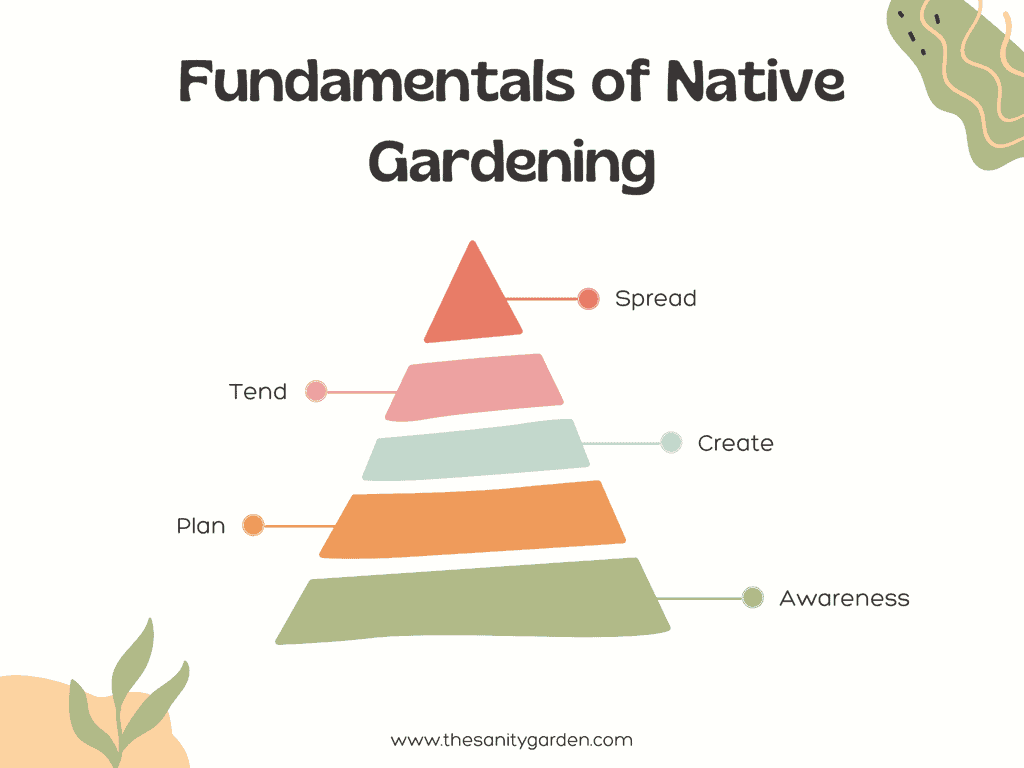
We’re visual creatures, right? That’s why I hope this pyramid is extra helpful.
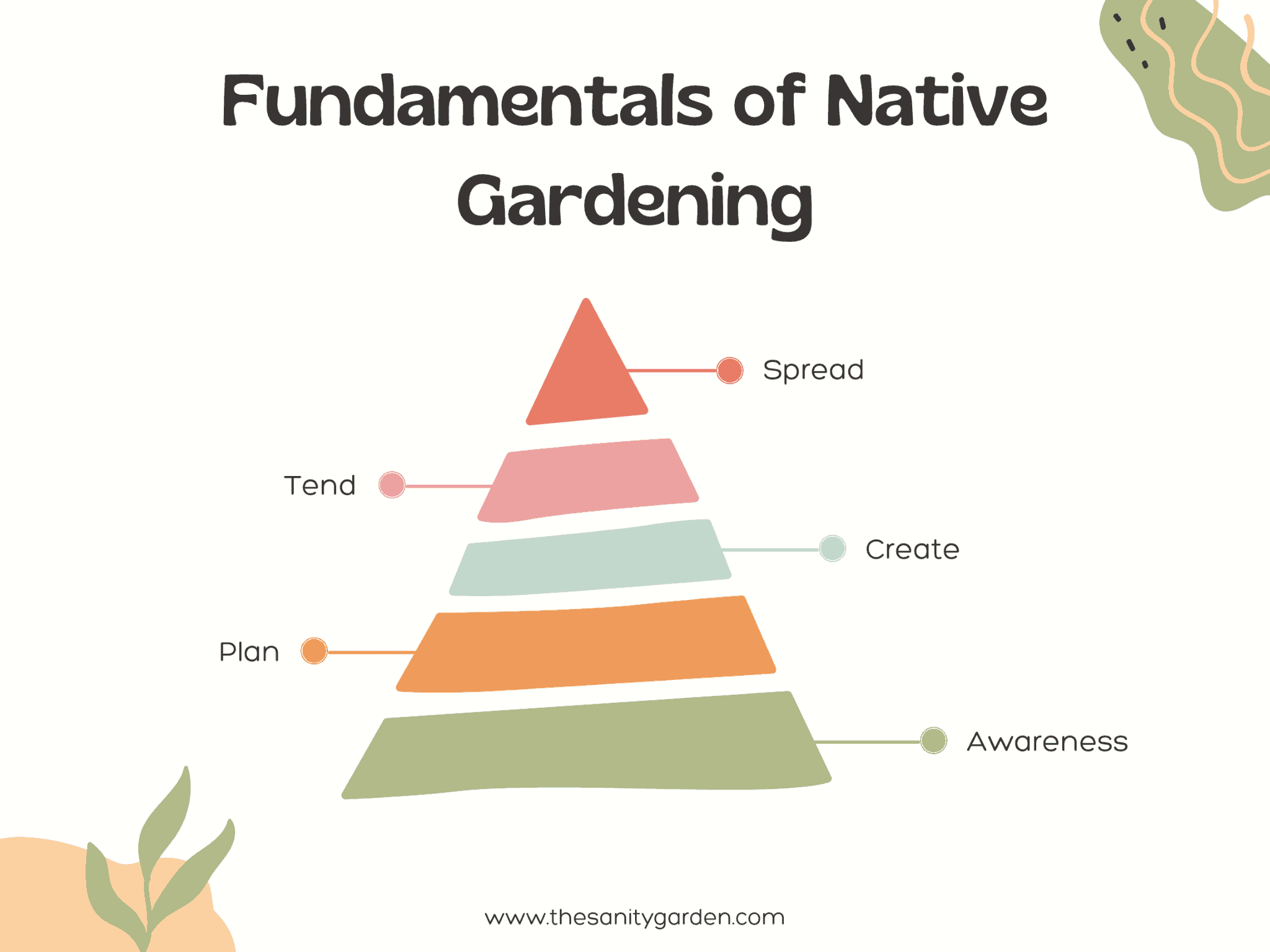
As you can see, we’ve got 5 layers to our pyramid of fundamentals: Awareness, Plan, Create, Tend, and Spread.
By beginning at the bottom and progressing strategically through each layer of the pyramid, you can enjoy a more streamlined and enjoyable native gardening process.
I’ll explain!
Fundamental #1: Awareness
As the base of the pyramid, Awareness is our bulkiest, strongest, most necessary fundamental.
What does “awareness” mean within the context of native gardening?
Awareness means acquiring knowledge related to:
- environmental distress on our planet
- climate challenges of our present and future
- toxic practices and patterns that undermine the health of our communities and our wild neighbors
- landscaping best practices that prioritize habitat, food sources, and ecosystem support
- modeling compassion and stewardship for our neighbors and next generations
- causes and leaders worth supporting and learning from
And more! That list is definitely not exhaustive.
Chances are that if you are here reading this post, you already have an understanding of native gardening and appreciate its increasing necessity within our communities. But awareness invites you to go deeper. It’s not about the technical ins and outs of planting – it’s more about the cultural and environmental conditions that make the planting critical.
Why does awareness matter?
Awareness develops your value system and defines your “why” for starting a native garden and removing turf grass around your home.
Once you have a firm sense of the problems that you hope to address by starting your native garden, you’ll have an easier time applying the other fundamentals and enjoying success.
Plus, this awareness backbone of your native gardening journey will give you hutzpah when the going gets tough.
Sweaty, buggy conditions outside? At least you have conviction about why you’re doing it!
Sticker shock at the gardening center? Consider it your donation to Mother Nature, she needs all the help she can get!
(To learn more about how to cultivate awareness, be on the lookout for my forthcoming *free* Native Garden Starter Kit!)
Fundamental #2: Plan
The next layer of the fundamentals is Plan, because we all know that rushing into anything without a plan often causes extra, unnecessary stress.
But before we explore Plan, this tier requires a short side trip into the realm of Capacity, Skills, and Resources. Consider this a sub-level of Planning.
Capacity, in short, refers to your overall bandwidth to accomplish your native gardening goals.
- How much time do I have to research, design, procure, install, and maintain my native planting?
- Are there parts of this process that light me up? Are there other parts that stress me out?
- How much decision-making, research, and troubleshooting can I handle?
- Am I physically capable of carting mulch around, digging, kneeling, bending, lifting, etc?
- What else is demanding my time and energy?
- Can I sustain the effort through establishment, not just installation?
Skills refers to your knowledge of soil, plants, climate, tools, planting techniques, eye for design etc.
- Do I feel comfortable enough with these skills to give them a whirl? Or is learning all of this going to eat into my overall bandwidth?
- Do I enjoy figuring things out, or would I rather have guidance?
- Which skills can I learn, and where would expert help make sense?
- Can I choose appropriate plants, estimate quantities, and work through setbacks?
Resources speaks to the physical, financial, and material resources that go into gardening.
- Is my financial situation sturdy enough for me to invest time and money into this project? (Budget for plants, materials, tools, delivery, and potential professional help.)
- Do I have access to tools, equipment, transportation, and the ability to move materials – even if I can’t do the work myself?
- Do I have helping hands, knowledgeable friends, or trustworthy professional referrals?
- Do I have access to local, reputable nurseries? Do they have the plants I want?
So: what does Planning mean in the context of native gardening?
Planning incorporates:
- Setting measurable goals
- Assessing your Capacity, Skills, and Resources
- Blocking time for research, design, procurement, site analysis & prep, planting, and maintenance
- Scheduling watering/weeding care during travel
Planning will save you lots of headaches. With the right game plan, you’ll end up with a native garden that feels like the right size for your sanity. It will be manageable and successful.
Fundamental #3: Create
The Create level is where you turn your plan into a living garden.
You get to break ground. Yay! When you’re creating, you’ll:
- Prep your garden site
- Install hardscaping (DIY or with a professional), as needed
- Go plant shopping!
- Install your plants according to your design
- Establish your garden
During this phase, I also love to think about what creature comforts and nice-to-haves I want outside with me in the garden during site prep and planting days. (Bluetooth speaker, homemade iced tea, a shade canopy, etc.)
Fundamental #4: Tend
Tending is the word I’m using to describe maintenance. Maintenance sounds too much like a chore, and, if your garden is well-planned, then weeding, trimming, and transplanting in your garden should feel more like a gentle act of tending than a feat of hard labor.
Tending is a tier of the fundamentals that never truly ends. There is no such thing as a garden without weeds, a garden without pests, or a garden that doesn’t occasionally need some TLC.
The good news? You can systematize tending so that it feels like a rewarding part of your routine. What better way to get up close and personal with the life that you’ve invited to your property than to thoughtfully maintain the garden? This is your chance to take pictures, cut a few flowers for your breakfast table, ID a mysterious caterpillar, and more!
Tending requires:
- Tool maintenance and smart storage
- Weeding
- Yard waste management
- Transplanting
- Pruning
- Replacing spent plants
- Editing the design
- Seasonal cut-backs
Fundamental #5: Spread
Just like the seeds in your new garden, your ethic is going to spread. Native gardening is a statement to your community that your yard matters and that you want to be part of the systemic changes we need to make.
When you grow confident with the other levels of the Fundamentals, you won’t be able to stop yourself from sharing what you know.
If friends and neighbors are curious about what they see around your home, you will become their go-to for knowledge.
And now you know just what to do: start them off at the Awareness level of the Fundamentals and they’ll be on their way!
Even if you never write an article, host a workshop, or answer a question about your native garden, the sight of it will speak a thousand words.
TLDR:
In brief, here are the Fundamentals of Native Gardening:
Awareness: Your yard matters.
Plan: You can figure out what makes sense.
Create: You can actually do it.
Tend: You can learn as you go.
Spread: You can share your skills and experience with others.
Happy planting!
-Kristen
